Web Design
Website Development Cost in Malaysia: A Line-by-Line Breakdown
What each line of a website quotation in Malaysia is for, what changes it, and what it costs in ringgit, with my own package prices as the reference.
 By Zahid Aramai
If you have asked three people for a quote and received three very different numbers, you already know the problem with the question “what is the website development cost in Malaysia?”. The honest answer is a range, and the range only becomes a number when you look at what each line of the quotation actually buys. This article goes through a quotation line by line: what the line is, what makes it cost more or less, and where it sits in my own packages. I am a freelance web designer in Kuala Lumpur and I have been building WordPress websites since 2009, so the ringgit figures here are the ones I quote, not a survey of the market.
A quick note on the numbers. Every price of my own services below comes from the packages I publish on my web design price page. I do not quote what hosting companies or plugin vendors charge, because those change and I would rather not print a figure that is out of date by the time you read it. Where a line is paid to a third party, I describe it without a price.
What a quotation is made of
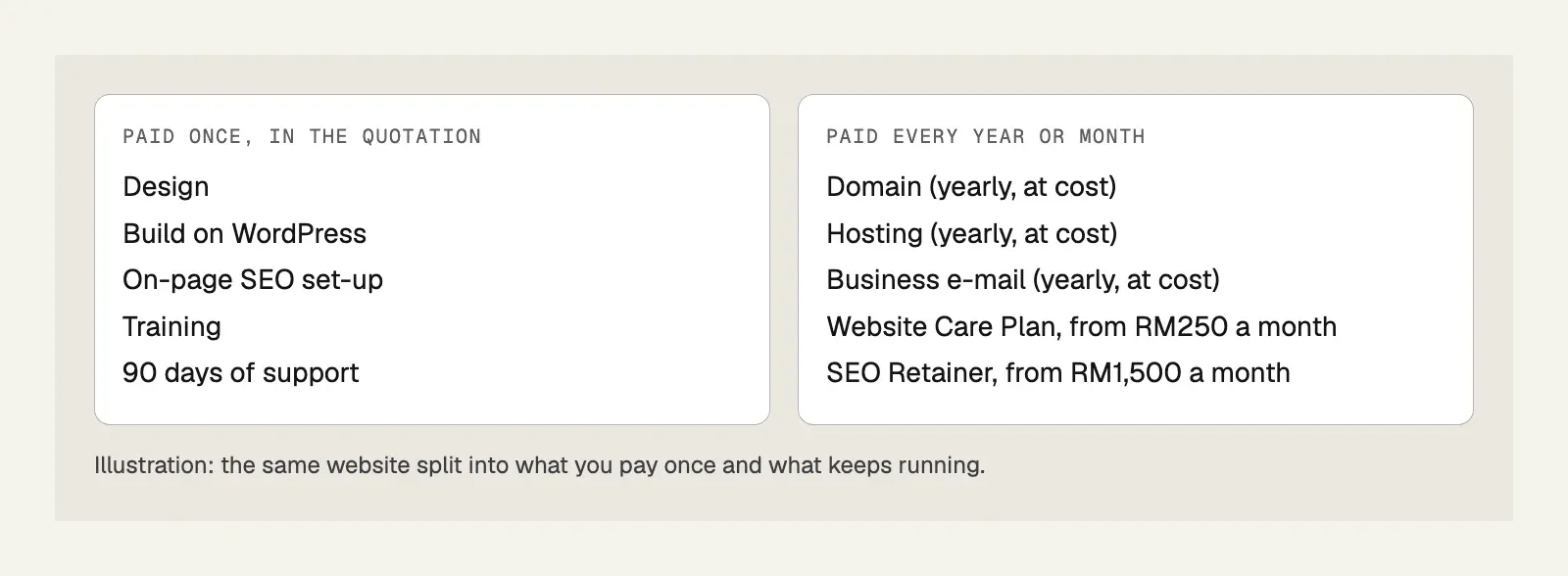
A website quotation is not one product. It is a bundle of separate jobs, some paid once and some paid every year. Most confusion about price comes from one quotation listing them separately and another hiding them inside a single total.
When I write a quotation, the lines usually come in this order: domain, hosting and e-mail, design, build, content, photography, SEO set-up, training, and care after launch. Not every project needs every line, and a small project may merge several. What matters is that you can see which ones are in, which ones are out and who pays for each.
The table below maps those lines to my packages. Where a cell names the work, it is part of the package price. “Quoted separately” means it is outside the package and I price it when we agree the scope.
| Quotation line | Landing Page, from RM2,500 | Business Website, from RM4,500 | WooCommerce Store, from RM7,500 |
|---|---|---|---|
| Domain, hosting, e-mail | Billed yearly at cost, or keep yours | Billed yearly at cost, or keep yours | Billed yearly at cost, or keep yours |
| Design | One custom page | Custom design, up to 8 pages | Everything in Business Website |
| Build | WordPress, mobile first | WordPress, up to 8 pages | Adds catalogue, gateways, shipping |
| Copywriting and photography | Quoted separately | Quoted separately | Quoted separately |
| SEO set-up | On-page SEO | SEO foundations and structured data | Everything in Business Website |
| Training | Not listed | One hour of WordPress training | Store management training |
| Support | 90 days free | 90 days free | 90 days free |
Read down any column and you can see what you are paying for. Read across any row and you can see what changes when the project grows.
Website development cost in Malaysia: the short answer
Before the lines, the range. I publish three market bands on my pricing page as context for anyone comparing options: do-it-yourself builders at RM300 to RM1,500 a year, a freelance web designer at RM1,500 to RM8,000, and a web design agency at RM5,000 to RM30,000 and above. Those are my own published bands, not an industry survey, and they overlap on purpose, because a senior freelancer can cost more than a junior agency team.
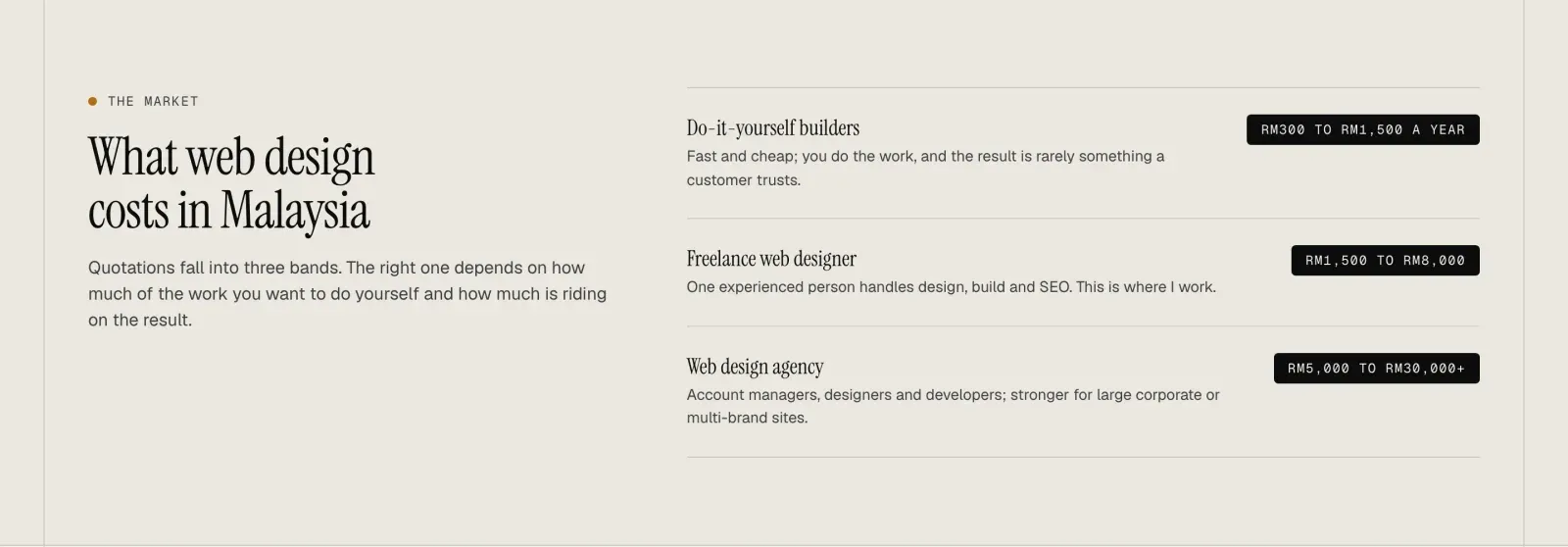
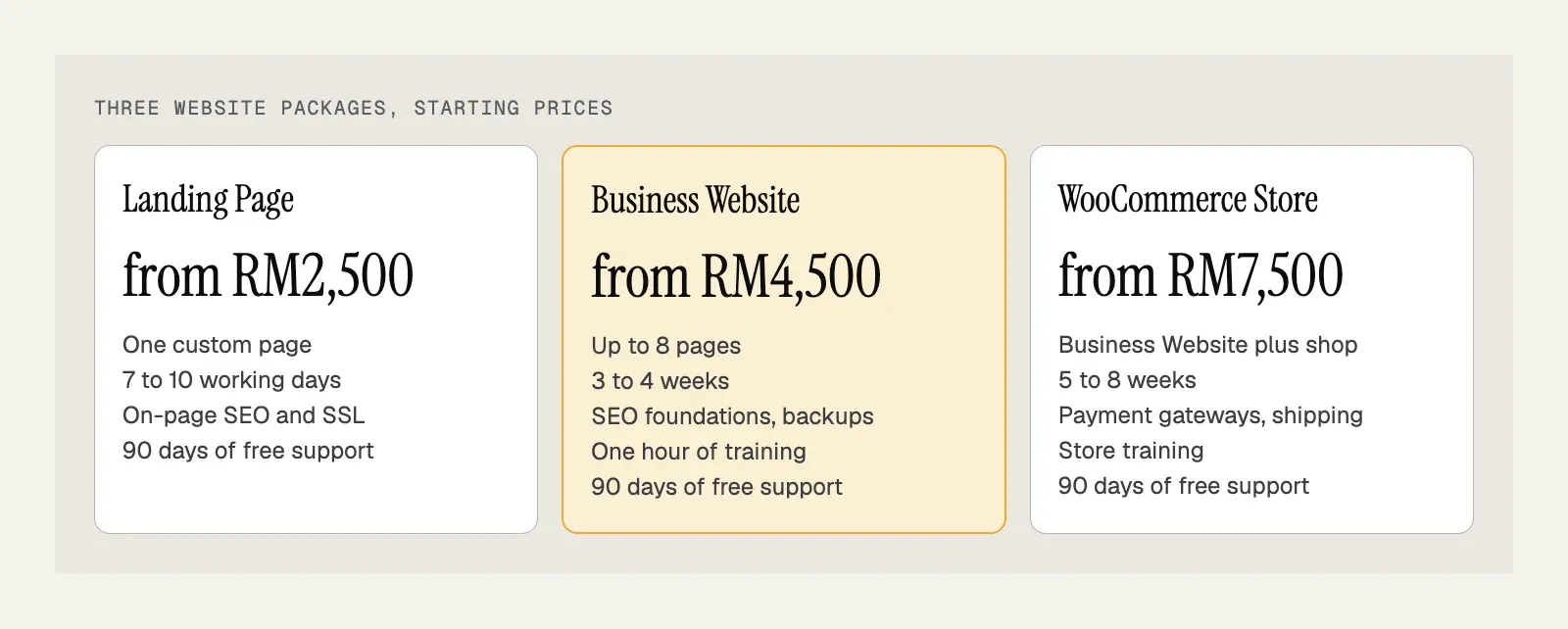
Where I work is the middle band. My three website packages start at RM2,500 for a landing page, RM4,500 for a business website and RM7,500 for an online store. The word “from” matters: it means the starting price for the scope described, with finished content ready. If you add pages, features or copywriting, the quotation changes, and you see the new figure in writing before any work starts.
If you are searching for a cost of web design, treat any single number you find online with suspicion, including mine. A number without a scope is just a marketing figure. The scope is what turns it into a price.
Domain, hosting and e-mail
The first lines on a quotation are the ones that are not design at all. A domain is your web address, such as yourbusiness.com or yourbusiness.com.my. Hosting is the server where the website files live. Business e-mail is the address on your own domain instead of a free webmail account.
All three are subscriptions. You pay them every year, whoever builds the site, and the fee goes to the provider, not to the designer. In my packages they are billed yearly at cost, or you keep the ones you already have. That is why they are in the “not included” list on my pricing page and not buried in a package total.
What changes this line is mostly where you buy them and what you need. A small brochure site needs modest hosting. A busy store needs hosting that stays fast when many people check out at once. I will not give you a ringgit figure here, because provider prices move, and the right choice depends on traffic. What I will say is that the line has to exist on the quotation, and the account has to be in your name.
That last point is the one I care about most. The domain, the hosting account and the WordPress site should be registered to you, and you should receive every login on launch day. If a quotation does not say who owns the domain, ask. It decides whether you can leave.
Design and build: where the project time goes
Design and build are the lines most people picture when they think of a website, and they are the biggest part of the package price. Design is deciding how the pages look and work: layout, type, colour, how a visitor on a phone gets from the first screen to a WhatsApp message. Build is turning that design into a working WordPress site.
I list them separately in my head, even when the quotation shows one figure, because they fail in different ways. A design that is not built well loads slowly. A build that is not designed well works but does not convince anyone. In my packages the design is custom, not a template with a logo pasted in, and the site is built mobile first, because most visitors arrive on a phone.
The price follows the number of different page designs more than the number of pages. A landing page is one design. A corporate site has four or five page types, such as home, about, services, projects and contact. A store adds product, category, cart and checkout templates. That is why the three packages start where they do.
The time follows the same pattern. These are the timelines in my packages, counted from the day the content is ready:
A longer build means more work, and the starting prices rise with the scope: RM2,500, RM4,500, RM7,500. It is also why a quotation that promises a full store in a week should make you ask what has been left out.
Content, copywriting and photography
This is the line that surprises people most. A package price covers the design and the build. It does not cover writing the words or taking the photos, unless we agree that and put a price on it.
The reason is simple. Text and photographs are separate jobs with separate skills. In my packages, finished content keeps the price at the package figure. If you need copywriting, translation or photography, it is quoted separately, or you supply it yourself.
I see this go wrong in one specific way. A business owner receives a quotation, assumes “website” means “everything”, and discovers in week two that the pages are empty and nobody is writing them. The designer is waiting for text, the owner is waiting for the designer, and the launch slips. This is the most common reason a project takes longer than the timeline in the package, which is counted from the day the content is ready.
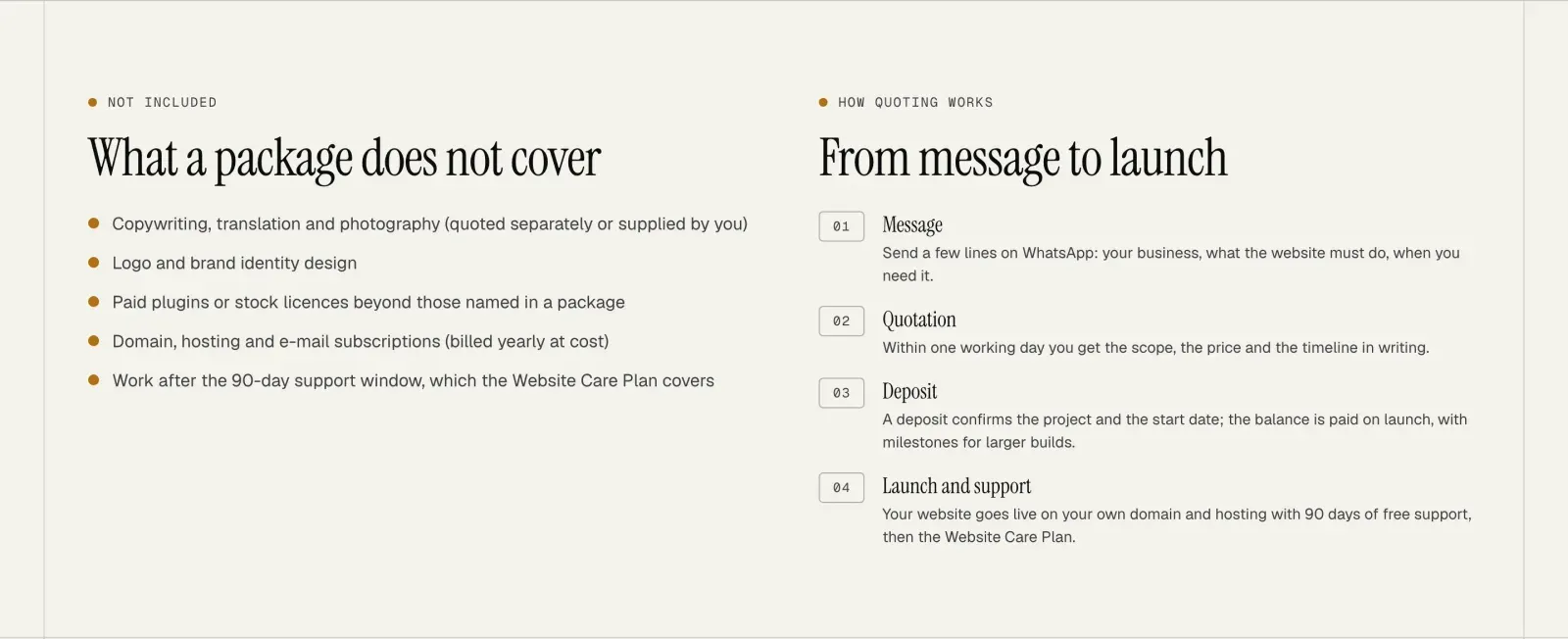
The same list on my pricing page also names logo and brand identity design, paid plugins or stock licences beyond those named in a package, domain, hosting and e-mail subscriptions, and work after the 90-day support window.
If you do not have text or photos yet, say so on the first call. We plan them together, and I give you a price for the part you want me to do. That is far better than finding out halfway through.
SEO set-up, training and life after launch
The last group of lines is what happens around the website rather than in it. They are easy to cut from a cheap quotation and expensive to miss.
SEO set-up means the basics that let Google understand the site: page titles and descriptions, headings, image descriptions, and structured data. In my Landing Page it is on-page SEO. In the Business Website it is SEO foundations and structured data, plus Google Business Profile and Maps integration. This is set-up, not a promise of rankings. Ongoing work to climb in search is a different service, the SEO Retainer, from RM1,500 a month with a minimum of three months. If you want to know the difference, read about SEO services in Malaysia.
Training means that you can edit your own site afterwards. The Business Website includes one hour of hands-on WordPress training, and the store includes store management training.
Support is the 90 days of free support that come with each website package. After that, a website still needs updates, backups and monitoring. That is what the Website Care Plan is for, from RM250 a month: WordPress core, theme and plugin updates tested before they go live, daily off-site backups, uptime and security monitoring, a monthly speed check, and two hours of content changes.
| Line | What it is | Where it sits with me |
|---|---|---|
| SEO set-up | Titles, descriptions, headings, image text, structured data | Inside the package price |
| Training | You learn to edit your own site | One hour in the Business Website, store training in the Store |
| First 90 days | Fixes and questions after launch | Free, in every website package |
| After 90 days | Updates, backups, monitoring | Website Care Plan, from RM250 a month |
| Ongoing search work | Keyword plan, monthly page or article, report | SEO Retainer, from RM1,500 a month |
A website with no plan for after launch is not cheap. It is a bill that has not arrived yet.
What changes the price
Given the lines, what moves the total? My pricing page lists six things that change a quotation. They are the same six that I think about every time I write one.
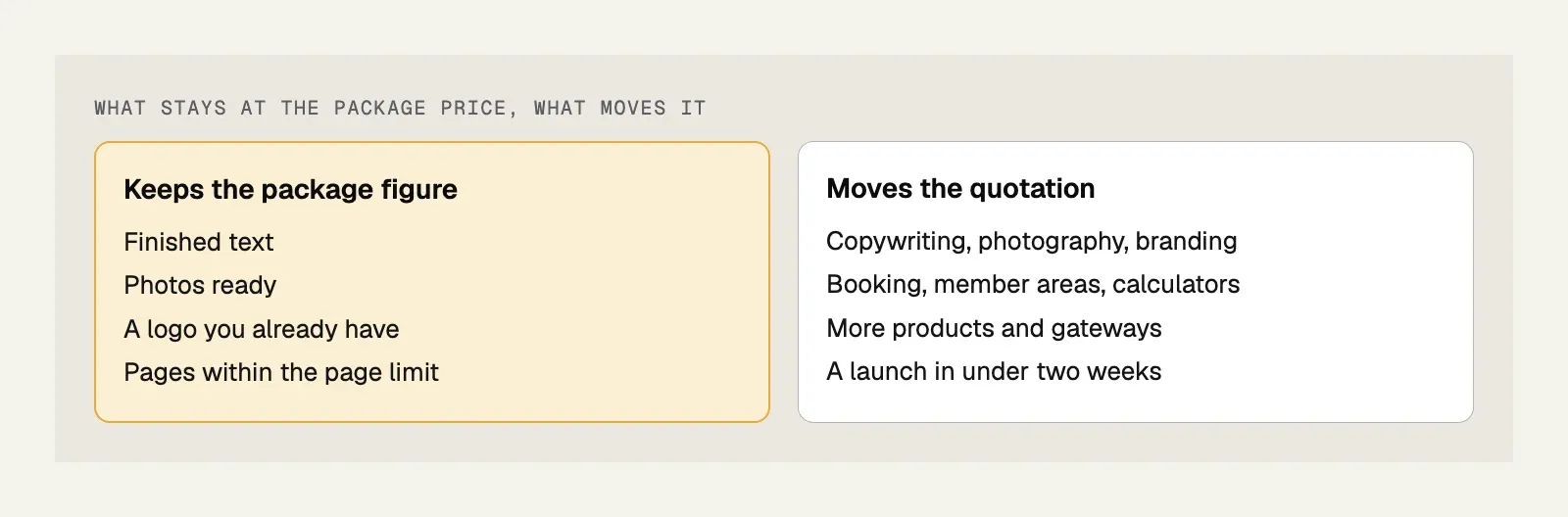
Here are the six, with how each one works in practice.
| Factor | How it changes the quotation |
|---|---|
| Number of pages and templates | A landing page is one design, a corporate site four or five page types, a store adds product, category, cart and checkout |
| Content readiness | Finished text, photos and a logo keep the package price; copywriting, photography and branding are quoted separately |
| Functionality | Booking systems, member areas, multilingual content, calculators and integrations are quoted per feature |
| Ecommerce complexity | The number of products, variations, payment gateways and shipping rules decides most of a store’s cost |
| Timeline | A launch in under two weeks is possible but priced as a rush job |
| Domain, hosting and e-mail | Billed yearly at cost, or you keep your existing provider |
Of the six, the one I would watch first is content readiness. It is the factor you control most and the one that moves a quotation least visibly. Having the text and photos ready before the first call is the cheapest way to save money and weeks.
If you want the wider picture of what pushes web design pricing up or down, I wrote an earlier article on the factors behind the price. This one is the 2026 ringgit breakdown, so it does not repeat that discussion.
How to read a quotation before you sign
Once you have two or three quotations, put them side by side and check each line. This is the checklist I would use if I were the one buying.
| Question to ask | Why it matters |
|---|---|
| Is every line named, with a price or “included”? | A single total hides what is missing |
| Who writes the text and supplies the photos? | The most common cause of delay and extra charges |
| Is the design custom or a modified template? | It changes how the site looks and how long it lasts |
| Is the domain, hosting and e-mail in your name? | It decides whether you can leave |
| What do I pay each year or month after launch? | The running cost is part of the real price |
| What happens in the first 90 days? | A support period should be written down |
| What is the payment schedule? | A deposit confirms the project and the balance is paid on launch, with milestones for larger builds |
Two mistakes I see most often on Malaysian quotations are both about comparing the wrong thing. The first is comparing totals instead of lines: a RM1,500 quotation and a RM4,500 quotation look comparable until you notice that one has no SEO set-up, no training, no support and a template design. The second is forgetting the running cost. A site that is cheap to build and costs more than you expected to keep alive is not cheap.
A third mistake is the opposite one: assuming the most expensive quotation is the safest. An agency may be the right choice for a large or multi-brand project. For most small and medium businesses in Malaysia, a clear quotation from one experienced person who will still answer the phone in a year is enough. I wrote about that choice in freelance web designer vs agency.
If you have a project in a specific field, such as a clinic, a contractor or a shop, my past projects show what has been built and how it is presented. For stores, see ecommerce website design in Malaysia.
Next step
The fastest way to turn this into your own number is to send me a few lines on WhatsApp: what your business does, what the website must do, and when you need it. Within one working day you get the scope, the price and the timeline in writing, with each line named. You can also see all six packages on the web design price page or message me directly at WhatsApp.