Web Design
Real Estate Website Design Malaysia: What Agents Need
What a real estate agent or developer website in Malaysia must do to bring enquiries: listings, WhatsApp, local search, speed and trust, and what it costs.
 By Zahid Aramai

Property is the industry where I get the most repeat enquiries from people who already have a website and are unhappy with it. The site exists, it has a logo and a photo of the Petronas Towers, and it brings nothing. The listings are out of date, the phone number is in an image, and the agent’s name does not appear on Google for the areas they actually work.
This article is for property agents, negotiators, small agencies and developers in Malaysia who want a website that produces enquiries rather than decorates a business card. It covers what the site must do, what it should contain, and what it costs.
What a real estate website is for
Buyers and tenants in Malaysia start on the portals and on Google, then check the agent. Owners deciding who to list with search the agent’s name and the area. The website has three jobs in that process.
First, to make the enquiry easy. In practice that means WhatsApp on every page and on every listing, with a pre-filled message that names the property. A form that emails you is a second option, not the first.
Second, to prove you are the right person for that area or that type of property. Sold and rented listings, area knowledge, and testimonials from owners do that better than any adjective.
Third, to be found. The agent who ranks for “condo for rent Mont Kiara agent” or “rumah untuk dijual Shah Alam ejen” gets the enquiry without paying a portal for the lead. That takes area pages written for the search, not a listings dump.
The path most visitors take, and where the website fits into it:
The pages that matter
A home page that says who you serve and where. Your name, your agency, the areas, the property types, and a WhatsApp button above the fold. Not a slideshow.
Listings you can update in minutes. A listing is a title, a few photos, the price, the size, the location and a WhatsApp button. Build it so that adding one takes five minutes from your phone, or it will not get done. Mark sold and rented ones as such instead of deleting them; they are proof.
Area pages. One page per area you really work: what the market is like, typical prices, the schools and the train station, your recent transactions there. These are the pages that rank. Ten thin pages for areas you never visit will not rank and will make the site look like a template.
About and testimonials. Buyers are handing you a seven-figure decision. Your REN number, your agency’s registration, how long you have been doing this and what owners say about you belong on one honest page.
A developer project page, if you are a developer or sell a project: the location, the unit types, the pricing band, the show unit booking, the progress photos, and a registration form that lands in WhatsApp or your CRM within seconds.
Here is how those pages fit together, and what each one asks the visitor to do:
| Page | Purpose | Call to action |
|---|---|---|
| Home | Who you serve and where | WhatsApp above the fold |
| Listings | Current, sold and rented units | WhatsApp that names the unit |
| Area pages | Rank for the areas you work | WhatsApp about that area |
| About and testimonials | REN number, agency, reviews | WhatsApp or call |
| Developer project page | Location, unit types, pricing band | Register or book the show unit |
Details that decide whether it works
Speed on a phone. Most property searches in Malaysia happen on mobile data, and a page full of uncompressed photos loads in eight seconds and loses the visitor. Images must be resized and compressed on upload, not left at camera size.
The Google Business Profile. Your Maps listing should match the website: same name, same phone, same areas. Reviews on the profile and the website pointing to each other is the cheapest ranking help you can get.
Lead tracking. Every WhatsApp tap and every form should be counted in Google Analytics so you know which page and which listing produced the conversation. Without it you are guessing where to spend your effort.
Ownership. The domain, hosting and WordPress login must be in your name. Agents who move agencies lose their website far too often because it was registered by someone else.
The four details in one place, with the warning sign for each:
| Detail | What good looks like | Warning sign |
|---|---|---|
| Speed on a phone | Photos resized and compressed on upload | Camera-size photos on every listing |
| Google Business Profile | Same name, phone and areas as the site | An old number on Maps |
| Lead tracking | Every WhatsApp tap and form counted | No idea which listing brought a message |
| Ownership | Domain, hosting and login in your name | Registered by an agency or a past designer |
What it costs and how long it takes
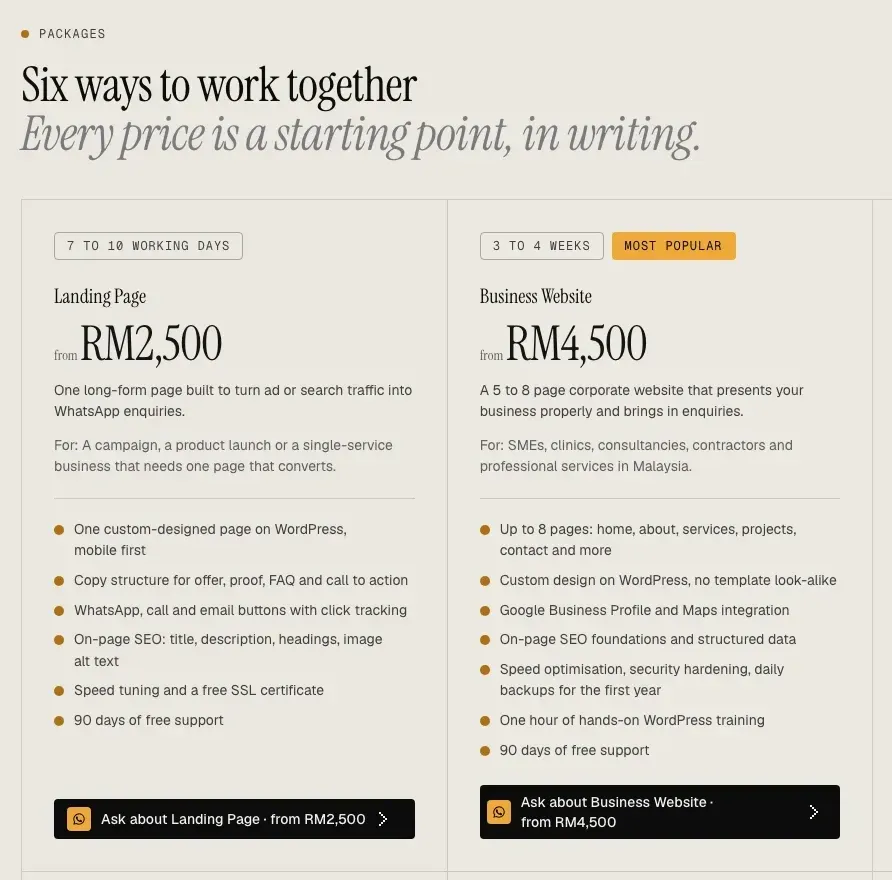
A single-page agent website with listings handled by a simple section and WhatsApp on everything starts at RM2,500 and takes about two weeks. A full agency site with a listings system, area pages, testimonials and lead tracking starts at RM4,500 and takes three to four weeks from the day the content is ready. Developer project sites are quoted on the project. Every figure is on the pricing page, and every project gets a written quotation first.
| Website | Starts at | Time |
|---|---|---|
| Agent website, one page | RM2,500 | About two weeks |
| Agency website | RM4,500 | Three to four weeks |
| Developer project site | Quoted | Per project |
| Care plan, optional | RM250 a month | From sign-up |
All of it is built on WordPress, which means you can add listings yourself, any designer can maintain it later, and the site keeps working when you change agencies. The platform choice and what a custom build includes are covered on the WordPress website design page.
Building a listing page that gets enquiries
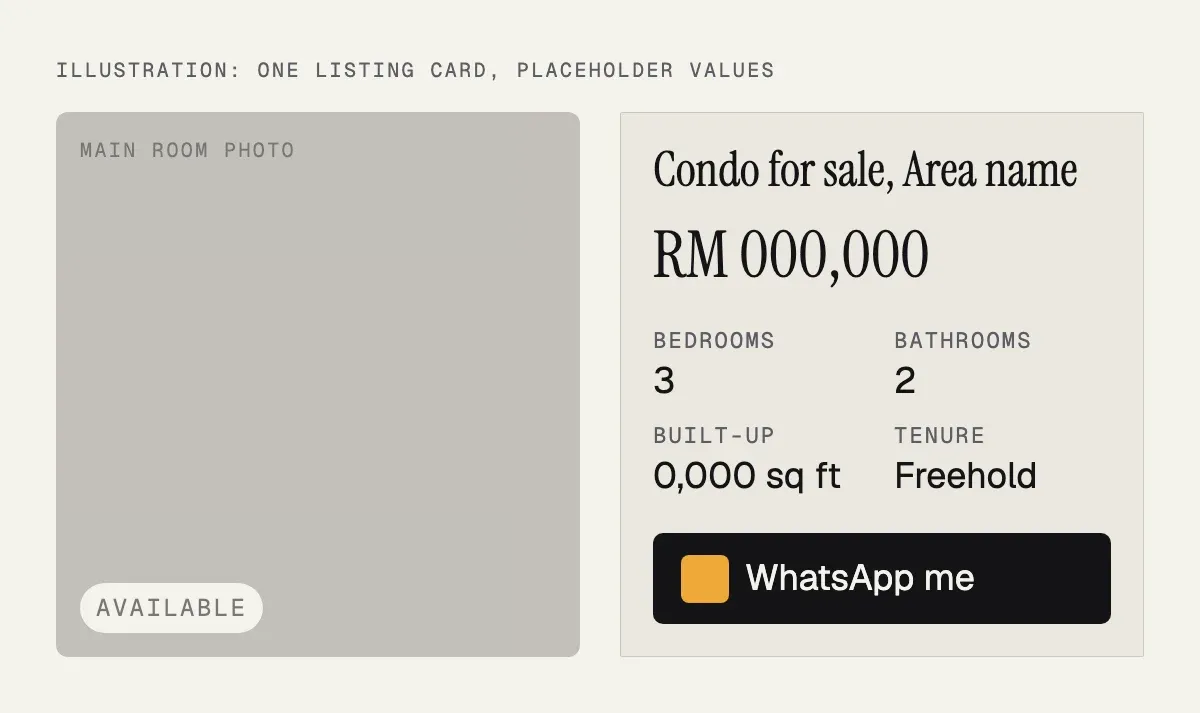
A listing page has one job: to make a serious buyer or tenant message you. Here is what the page should hold, in the order the visitor looks for it.
Title and price first. Property type, area and the asking price or rent, in text and not in an image. Add the tenure and furnishing status if they apply, because those are the first questions anyone asks.
Key facts in a short block. Built-up size, bedrooms, bathrooms, car parks, floor level, tenure and the condition. Use the same order on every listing so repeat visitors can compare quickly.
Photos that match the facts. Real photos taken at a decent hour, with the main room first. Resize them before uploading. Do not use another agent’s photos or a developer’s render as if it were the unit.
A short description in your own words. What is near, why this unit, what the owner is willing to discuss. Two or three short paragraphs, not a block copied from a portal.
One clear action. A WhatsApp button that opens a message naming the property, for example “Hi, I am interested in the unit at [project name], is it still available?”. A map pin for the area, not for the exact unit if the owner prefers privacy.
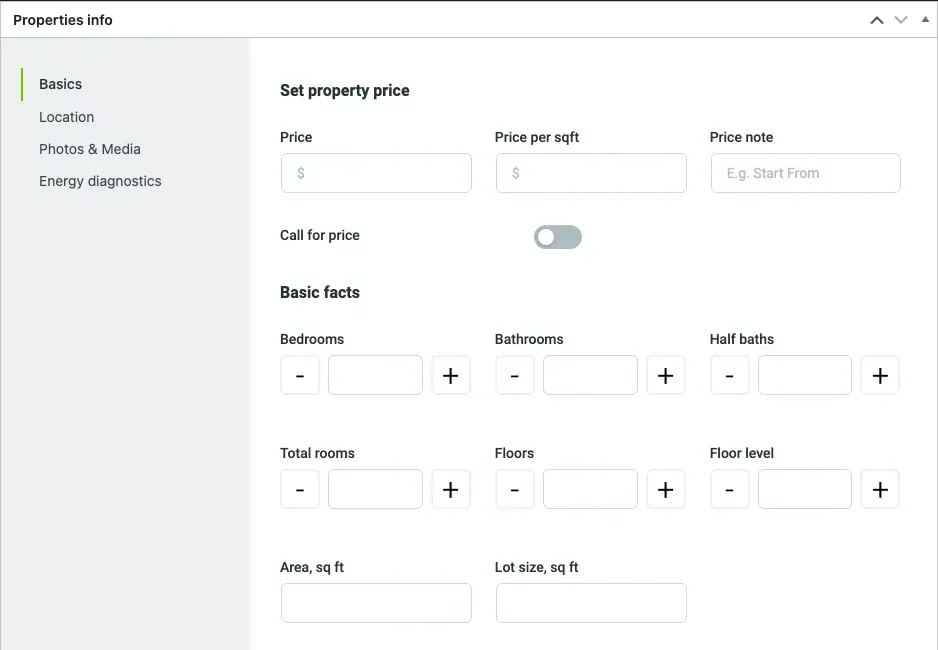
Most WordPress real estate plugins give you these facts as form fields. This is one free plugin’s add-listing screen:
Status. Available, under offer, sold or rented. Keep sold and rented listings online with the status marked. They show a new visitor that you close deals.
Registration, trust and what to show
Buyers and owners in Malaysia are right to check who they are dealing with. Estate agents and negotiators operate under the Board of Valuers, Appraisers, Estate Agents and Property Managers (BOVAEP), and registration is shown as a number. Show yours clearly on the site: your registration number as a negotiator (REN) or probationary agent (PEA) where it applies, and your agency’s registered estate agent (REA) details. Use exactly the format on your registration, and check the current BOVAEP rules on what advertising must display, because those requirements can change.
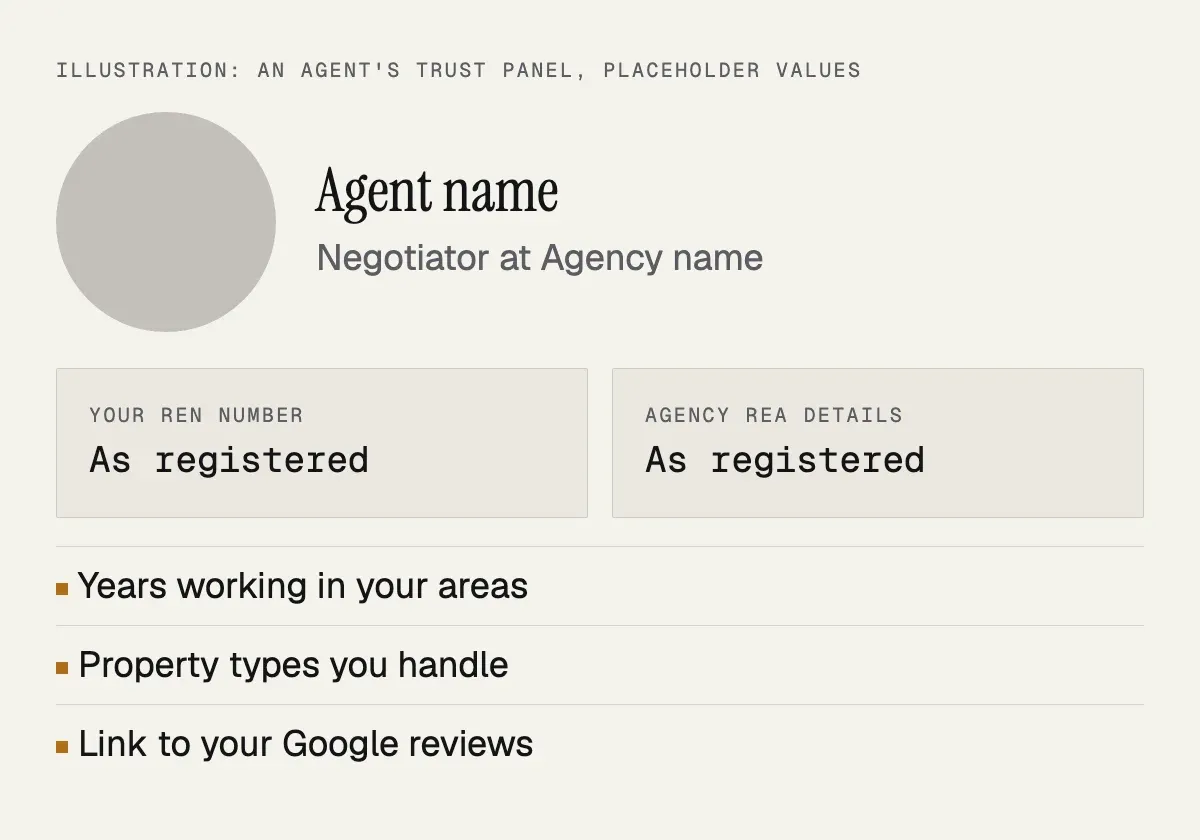
Beyond the number, trust comes from specifics: how many years you have worked in an area, the types of property you handle, how you communicate with owners, and reviews from real clients with their permission. Link to your Google reviews rather than retyping them, so a visitor can see they are genuine.
| What to show | Where on the site | Why it helps |
|---|---|---|
| Your REN or PEA number, as registered | About page, footer, contact area | A buyer or owner can check you |
| Agency REA details | About page and footer | Shows who you work under |
| Years in your areas | About and area pages | Specific, checkable experience |
| Property types you handle | Home and about pages | Owners see you know their type |
| Link to your Google reviews | About page and listings | Visitors see the reviews are genuine |
What an area page should contain
The area pages are the best long-term asset on the site, and they are the pages most agents write badly. A useful area page covers:
- Who lives there and what the housing is. Condominiums, landed homes, older low-cost flats or new developments, in plain terms.
- Getting around. The nearest LRT, MRT or KTM station if there is one, the main highways and the usual traffic pain points. Be honest about them.
- Daily life. Schools, malls, markets, clinics and food. Name the places you actually know.
- Prices and rents. Describe the range you see in your own deals, and say it is from your experience. Do not publish figures you cannot support.
- Your deals there. Recent sold and rented properties, with links to their listing pages.
- How to contact you. A WhatsApp button and a short note on how you help buyers, tenants or owners in that area.
Write each page for someone deciding whether to move there, not for a search engine. The search benefit follows. If you work in several areas across Kuala Lumpur and Selangor, the pages on web design in Kuala Lumpur and web design in Selangor show how I handle local pages for other businesses.
Common mistakes on property websites
- Listings that were sold a year ago still shown as available. A buyer who calls about a gone unit never calls again.
- Phone numbers and prices embedded in images, which cannot be tapped, searched or read by Google.
- Copying portal descriptions word for word, which gives Google no reason to rank your page above the portal’s.
- Giant uncompressed photos and autoplay video that make the page unusable on mobile data.
- No privacy notice on the enquiry form. If you collect names and phone numbers, say what you will do with them.
The same mistakes, with what each one costs and the fix:
| Mistake | What it costs | Fix |
|---|---|---|
| Sold units still shown as available | The caller does not call again | Change the status the day it changes |
| Phone and price inside images | Cannot be tapped, searched or read by Google | Put them in text |
| Portal descriptions copied word for word | No reason to rank above the portal | Write it in your own words |
| Huge photos and autoplay video | Unusable on mobile data | Resize photos, remove autoplay |
| No privacy notice on the form | Visitors do not know how their details are used | A short notice beside the form |
Developers and project microsites
A developer site works differently from an agent site. The visitor is deciding about a unit that does not exist yet, so the site must make the project feel real and credible. Show the location on a map, the unit types with floor plans, the facilities, the developer’s track record with completed projects, and the approval and licence details that the law requires you to disclose in advertising. Check the current requirements with your lawyer or the regulator rather than relying on a designer for that.
Then make the next step easy: a registration form that goes straight to the sales team’s WhatsApp, and a booking option for the show unit or gallery. Update progress photos on a schedule, because buyers of an under-construction unit want to see the site moving. A single project usually needs a project page or a small microsite, not a full listings system. If you want help scoping it, the services page lists what I build.
How to judge whether the site is working
Check three numbers every month: how many people tapped WhatsApp, which pages they were on, and how many of those conversations turned into viewings. The first two come from the site’s analytics; the third only you know. If WhatsApp taps are low, the problem is usually the page or the offer. If taps are high but viewings are low, the problem is usually the follow-up. Either way, you are working from facts rather than hunches.
| Number | Where it comes from | What it tells you |
|---|---|---|
| WhatsApp taps | Site analytics | Whether pages make people message |
| Pages and listings tapped on | Site analytics | Which listings and areas work |
| Viewings from those chats | Your own records | Whether the follow-up converts |
A note on portals and social media
Keep using them. The portals bring volume and social media brings attention; the website is where both are converted into a conversation that belongs to you. A buyer who saw your listing on a portal and your face on Instagram will still search your name before messaging, and the website is what answers that search with your transactions, your reviews and your number. Put the website address on every portal listing and every post, and watch the enquiries that mention it. Those are the ones that found you, not the portal.
How the three channels compare:
| Question | Portals | Social media | Your website |
|---|---|---|---|
| Whose brand is on the page | The portal’s | The platform’s | Yours |
| Where the enquiry can go | Any agent on the portal | You, inside the app | Only you |
| What it is best at | Volume | Attention | Turning both into a conversation |
| What a name search finds | One listing | Your posts | Your deals, reviews and number |
Next step
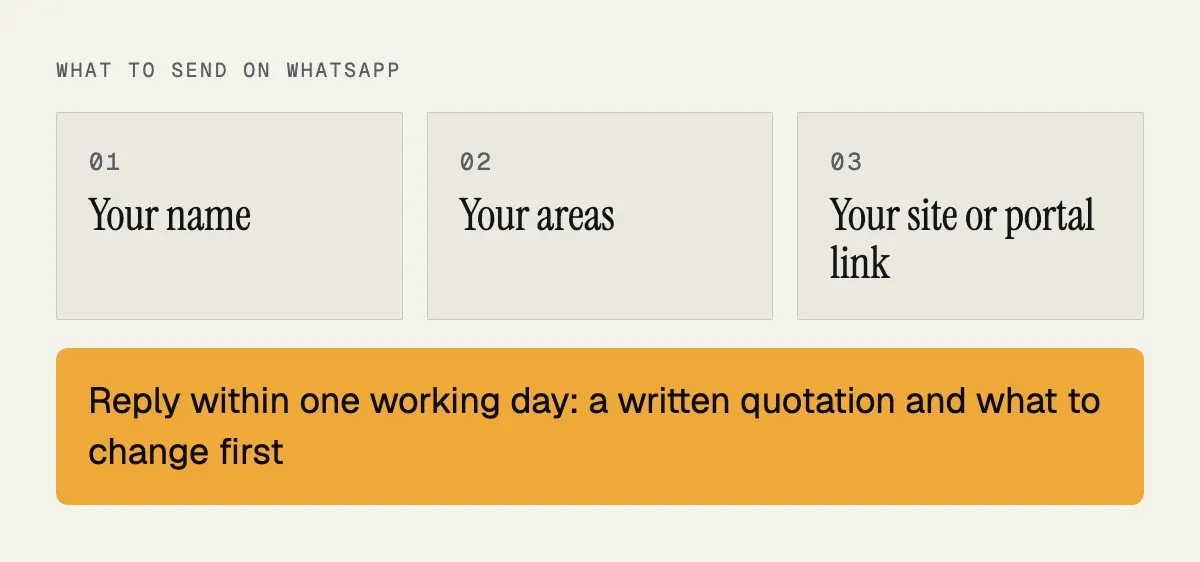
If you are an agent or developer in Kuala Lumpur, Selangor or anywhere in Malaysia, send your name, your areas and a link to your current site or portal profile on WhatsApp. I reply within one working day with a written quotation and a short list of what I would change first.